
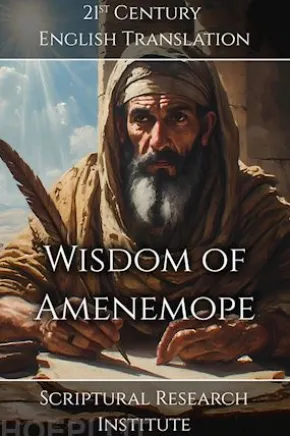
Wisdom of Amenemope
€2.54
Compatibilità
- Computer
- Android
- Ebook Reader
- iPhone/iPad”
- Kindle
Dettagli
Genere:E-book EPUB
Lingua: Inglese
Editore:
Digital Ink Productions
Pubblicazione: 04/2026
Trama
The Wisdom of Amenemope is an ancient Egyptian text that has mostly survived to the present, dating to sometime between 1573 and 1374 BCE. It is also called the Wisdom (or Instructions) of Amenemopet, depending on how the Egyptian name Amen-em-ope is rendered. It served as an inspiration for several ancient Israelite books, including the Deuteronomy, Psalms, Proverbs, and the Wisdom of Joshua ben Sira. The most significant influence of Amenemope on the Israelite texts is found in the book of Proverbs, which copies some of Amenemope verbatim. The Wisdom of Amenemope was lost for over 2000 years, however, in the late 1800s, several copies were found by Egyptologists both on papyrus and tablets. The various copies all dated to the 21st through 27th dynasties of Egypt, circa 1170 to 500 BCE, meaning the Wisdom of Amenemope was in circulation for over 600 years before being lost. It is not clear when exactly it was lost, but it was no longer in circulation by the time the Septuagint was translated at the Library of Alexandria circa 250 BCE, and there is no evidence the Library ever acquired a copy of it.
Its date of origin is equally obscure, and a wide variety of dates have been proposed. The text refers repeatedly to Aten along with Ra, which strongly implies a pre-Akhenaten origin. During the 18th dynasty, circa 1374 to 1357 BCE, Pharaoh Amenhotep IV changed his name to Akhenaten and mandated that everyone in Egypt had to worship Aten, the solar disk. Before this, Aten was worshiped as one of many gods, and viewed as one aspect of Ra, the sun god, specifically the dawn. Once Atenism became the state religion, the other gods were first demoted to secondary status, and then banned outright. This was not a popular decision, and after he died the order imposing Atenism on Egypt was rescinded, and in the following dynasty, virtually all trace of Akenaten was purged from Egypt.
The purge of Akenhaten was so thorough that even the Late Period Egyptians and Greeks that occupied Egypt did not know he had existed. His existence and the nature of his existence were rediscovered in the early 1900s when the tomb of his son Tutankhamun was discovered. Tutankhamun had originally been named Tutankhaten, but changed his name to Tutankhamun after his father died, replacing the name of the god Aten with Amen. This signified that the royal family had reverted to the worship of Amen and had abandoned Aten. Aten continued to be worshiped for a few years into Tutankhamun’s reign but seems to have been completely abandoned by the Egyptians within a decade, and then disappeared from the Egyptian pantheon. The disappearance of Aten after the time of Tutankhamun means that Amenemope could not have written his text after Tutankhamun.
Its date of origin is equally obscure, and a wide variety of dates have been proposed. The text refers repeatedly to Aten along with Ra, which strongly implies a pre-Akhenaten origin. During the 18th dynasty, circa 1374 to 1357 BCE, Pharaoh Amenhotep IV changed his name to Akhenaten and mandated that everyone in Egypt had to worship Aten, the solar disk. Before this, Aten was worshiped as one of many gods, and viewed as one aspect of Ra, the sun god, specifically the dawn. Once Atenism became the state religion, the other gods were first demoted to secondary status, and then banned outright. This was not a popular decision, and after he died the order imposing Atenism on Egypt was rescinded, and in the following dynasty, virtually all trace of Akenaten was purged from Egypt.
The purge of Akenhaten was so thorough that even the Late Period Egyptians and Greeks that occupied Egypt did not know he had existed. His existence and the nature of his existence were rediscovered in the early 1900s when the tomb of his son Tutankhamun was discovered. Tutankhamun had originally been named Tutankhaten, but changed his name to Tutankhamun after his father died, replacing the name of the god Aten with Amen. This signified that the royal family had reverted to the worship of Amen and had abandoned Aten. Aten continued to be worshiped for a few years into Tutankhamun’s reign but seems to have been completely abandoned by the Egyptians within a decade, and then disappeared from the Egyptian pantheon. The disappearance of Aten after the time of Tutankhamun means that Amenemope could not have written his text after Tutankhamun.
Be the first to review “Wisdom of Amenemope”
Related products

Ebook
€6.71

€25.49


€16.91

€14.44

Ebook
€3.39

€7.56

€6.79

Biografie
€5.86

Ebook
€14.36

Ebook
€6.71


Ebook
€3.39

Ebook
€0.76


Ebook
€18.61

Reviews
There are no reviews yet.